Operational transparency as a short-form video strategy, tested through 45 videos for a Mercedes-Benz truck repair service.
Content teams are constantly searching for the next format that will work: trends, Q&A series, UGC mechanics, mini-series, expert videos. One of the most durable sources of short-form material receives almost no attention, although it produces new episodes every working day. Marketers did not invent it, and it predates every current platform. The restaurant industry demonstrated it decades ago, and operations research has since explained the mechanism. This article sets out the model, the evidence, and a case from a niche not usually associated with mass audiences: a Mercedes-Benz truck repair service.
Cooking in front of guests has existed for a long time. What changed in the second half of the twentieth century was that open kitchens began appearing in fine-dining restaurants as a deliberate part of the customer experience.
One of the best-known examples is Wolfgang Puck’s Spago, which opened in Los Angeles in 1982. Puck’s original motivation was operational: from the open kitchen, he could supervise the cooks and the dining room at the same time while talking to guests. The effect on customer perception was a byproduct. In a later interview, Puck recalled: “When Spago opened, the kitchen effectively became a stage.” The wall that had separated the chef from the guest was gone, and work that had always happened, including cooking, cutting, frying, and assembling dishes, became part of the experience.
For content strategy, the important detail is what actually changed. The work itself stayed the same; the wall that hid it from the guest came down, and the process became visible to the person paying for it. Short-form video lets almost any business do the same: the camera gives the customer a view of work that is already happening. The model extends far beyond restaurants.
Every Service Business Already Produces Raw Material
A working day at any service company consists of jobs: diagnosing, repairing, assembling, designing, servicing, procuring. Marketing usually builds a separate production process on top of that — content production — and plans it independently: idea generation, trends, references, jokes, dances, formats for next week. The two processes rarely touch, even though the more reliable source of material is often in the next room.
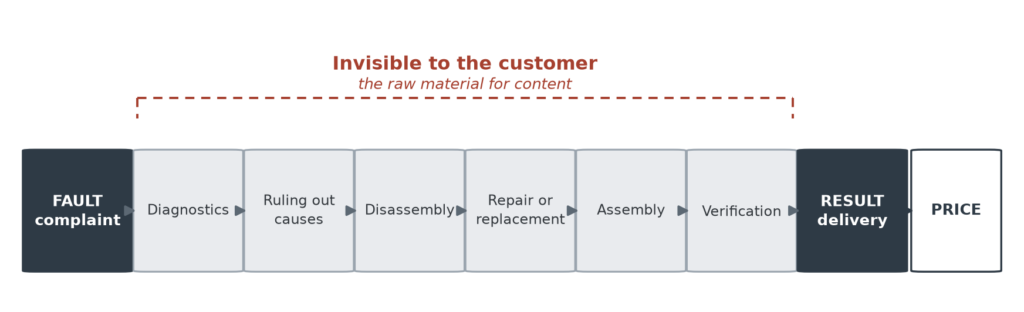
Consider an ordinary repair job. A customer brings in a vehicle with a fault. The mechanic takes the complaint, runs diagnostics, rules out possible causes, isolates the fault, disassembles the unit, replaces or repairs parts, reassembles everything, and verifies the result. The customer sees the beginning of this chain and its end: the fault, then the repaired vehicle and the invoice. Everything in between is invisible to them.
That invisible middle is a content series with a structurally renewable supply. Every incoming job is a new episode, and the format runs out only if the business stops working. In my experience, this changes the first question of short-form planning. Instead of “What should we shoot?” it becomes:
“What are we doing today that our customer usually never gets to see?”
45 Videos, 16 Million Views
I tested this approach in a narrow B2B niche: a Mercedes-Benz truck repair service. The editorial plan was built around incoming jobs rather than a content calendar — faults, diagnostics, mechanics at work, unusual cases, completed repairs. Everything shown in the videos actually happened in the service center; nothing was staged.
Forty-five videos across four platforms generated more than 16 million organic views and brought the accounts more than 11,000 followers. On VK, the platform where we could track inquiries, about 780,000 views produced 68 inbound B2B inquiries.
Two observations on these numbers. First, the commercially significant figure is the smallest of them: 68 inquiries on a single platform. Ordinary daily work became a measurable source of demand. Second, the other three platforms did not track inquiries, so the full commercial effect is undercounted here rather than inflated. The topic supply renewed itself through customer jobs: every new truck potentially carried the next episode.
Why Visible Work Changes How the Service Is Valued
The effect that makes this content work has a name in operations research: operational transparency — making work that normally happens backstage visible to the customer. Table 1 summarizes the studies relevant to this argument.
Study
Setting
Finding
Buell & Norton (2011), “The Labor Illusion,” Management Science
Experiments with simulated online services
Under some conditions, customers rated an outcome more highly when they could observe the work behind it; the authors called this the “labor illusion.”
Buell, Kim & Tsay (2017), “Creating Reciprocal Value Through Operational Transparency,” Management Science
Field experiment in food service in which customers and employees could see each other during order fulfillment
Customer-reported quality rose by 22.2%; the time it took to complete orders fell by 19.2%
Laboratory follow-up experiments
Laboratory service settings
By observing the process, customers perceived employee effort as more substantial, valued the work more, and rated the service more highly
2025 study of 702 restaurant customers
Restaurants
Found a connection between perceived transparency, trust, loyalty, and willingness to recommend the restaurant
The mechanism matters for any service business. A typical service job contains an asymmetry between what the customer sees and what the work actually involves.
Pavel Kondratenko is a social media and digital marketing professional with over six years of experience in social strategy, content, and organic growth. He has built multi-platform content systems generating more than 16 million organic views and is currently developing an AI-powered video content product.
To provide the best experiences, we use technologies like cookies to store and/or access device information. Consenting to these technologies will allow us to process data such as browsing behavior or unique IDs on this site. Not consenting or withdrawing consent, may adversely affect certain features and functions.
Functional
Always active
The technical storage or access is strictly necessary for the legitimate purpose of enabling the use of a specific service explicitly requested by the subscriber or user, or for the sole purpose of carrying out the transmission of a communication over an electronic communications network.
Preferences
The technical storage or access is necessary for the legitimate purpose of storing preferences that are not requested by the subscriber or user.
Statistics
The technical storage or access that is used exclusively for statistical purposes.The technical storage or access that is used exclusively for anonymous statistical purposes. Without a subpoena, voluntary compliance on the part of your Internet Service Provider, or additional records from a third party, information stored or retrieved for this purpose alone cannot usually be used to identify you.
Marketing
The technical storage or access is required to create user profiles to send advertising, or to track the user on a website or across several websites for similar marketing purposes.