In February 2026 ChatGPT passed 900 million weekly users, twice the figure of a year earlier. It has become the first place a customer goes for advice on what to buy, and the numbers behind that shift moved fast. Adobe measured AI-referred traffic to US retail in Q1 2026 at 393% above the prior year. In March those visitors converted 42% better than non-AI traffic. Twelve months earlier the same channel converted 38% worse. The customer now forms an impression of your brand inside a conversation you never see, before opening your site. Most brands still run this channel with no owner and no budget line.
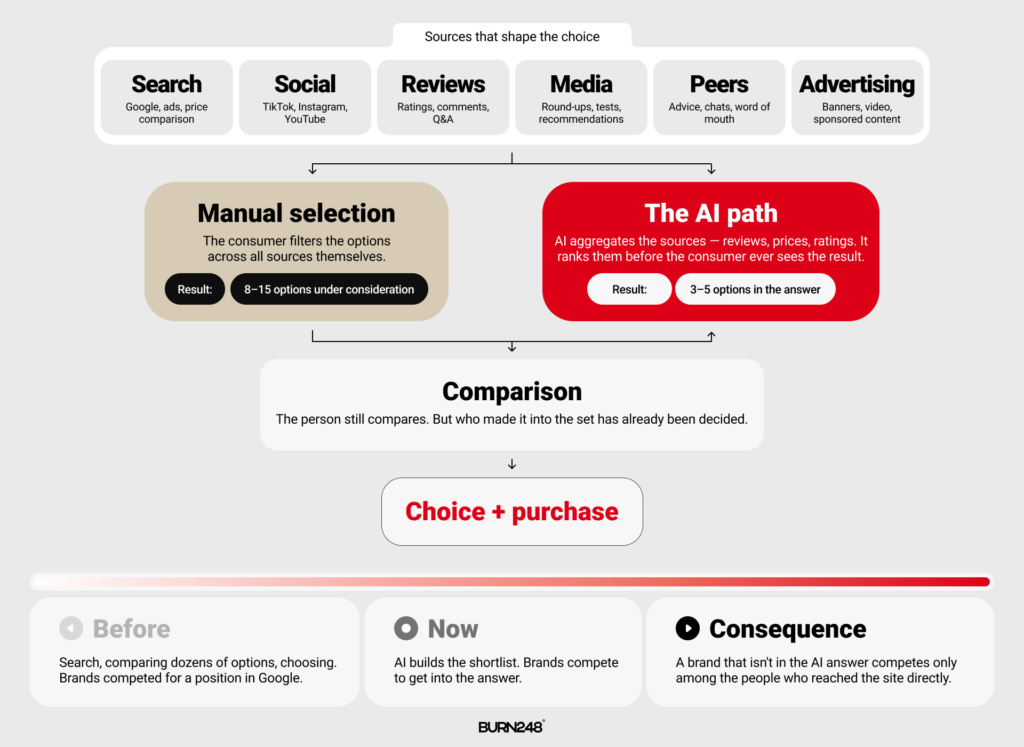
For ten or fifteen years Google served as one of the main distribution channels. The customer searched, compared, and chose. The brand paid for ads to sit among those options. AI is taking that role over. A prospect asks the model, gets three to five options, then opens Google to check prices, reviews, sites. He compares the brands the model named. The ones he would have found on his own never enter the comparison.
Shopify’s Q1 2026 commerce data shows what that behavior looks like on the merchant side. More than half of AI-referred sessions land directly on a product page. For organic search the figure is 20%. The customer arrives having already decided. Discovery and comparison happened inside the chat. The same data set puts AI-referred conversion nearly 50% above organic search on product pages, with orders carrying 14% higher average value, and shows AI outperforming organic in 23 of 25 merchant categories.
Google hasn’t disappeared. It is turning from the channel where the customer builds a shortlist into the channel where he confirms one. The shift runs fastest in categories with long comparison cycles, electronics, travel, finance, and slower in routine purchases where the customer goes straight to a familiar site. Betting on Google alone now means paying for a choice the customer made earlier, inside AI.
Diagram: Two consumer journeys, manual shortlisting and AI shortlisting
You no longer decide what AI says about you
When a customer asks ChatGPT what to buy or which brand to trust, the recommendation rests on what other people write about you: marketplace reviews, YouTube teardowns, press coverage, forum threads. What you publish on your own properties carries far less weight, and there is now hard data on how much less.
Ahrefs ran the largest public study on this question, 75,000 brands, measuring which signals predict a brand’s presence in AI answers. Branded web mentions correlated with AI visibility at 0.664. Backlinks, the metric a decade of SEO budgets was built on, came in at 0.218. The three strongest signals in the study all sit off-site. Muck Rack’s May 2026 study reaches the same place from another angle: across more than 25 million links cited by ChatGPT, Claude and Gemini, earned media accounted for 84% of citations and paid or advertorial content for 0.3%.
Advertising inside ChatGPT exists, and it sits outside the answer. In February 2026 OpenAI launched a separate ad unit marked “sponsored”, in its own zone. You can buy that unit, but you cannot buy a place among the brands the model names on its own, and the customer reads those names as the model’s independent judgment. That is why he trusts them. Two standard marketing levers, SEO on your own site and paid traffic, do almost nothing for that selection. For a customer who starts his choice in AI, a brand outside the answer might as well not exist. Adobe’s data says that group grew fivefold in a year.
The money has started moving, the playbook hasn’t
Brands have begun treating the answer as a budget question. Butterball hired Carmichael Lynch as its agency of record this year partly for the agency’s AI visibility capability. The brand’s VP of marketing named his small internal team as the reason it became a selection criterion. Priceline is running a ChatGPT ads pilot alongside heavier social spend to map the new shopping journey. Neither company disclosed figures.
What is missing from both stories is not budget. Adobe ran its content visibility checker across US retail and scored the average homepage at 75%, meaning a quarter of the content on it sits unreadable to the models. Category pages score no better, and the spread runs from 82.5% at the strongest retailers to 54.2% at the weakest. These are the same sites now absorbing 393% more AI traffic. Spend is moving faster than the operations underneath it, and a larger budget does not close that gap.
Three moves at the structural level
The company’s own structure creates the obstacle here, not the idea.
One. Assign an owner. By default this task has none. SEO sees PR work in it, performance sees organic, communications sees a technical job for digital. You need one person with real authority and a budget, instead of responsibility split across three teams. Put that person in the function that builds reputation in independent sources. In B2B and complex sales, that sits closer to PR and expert presence; in e-commerce, closer to marketplace and review management. Butterball answered the question by writing it into agency selection. An answer through a hire or an internal mandate works too. Any of these beats the default, which is nobody.
Two. Make the trade-off. Trying to appear in every AI answer at once will fail. You build visibility against a specific query, and resources spread across the whole category produce nothing on any of it. Pick the few queries where the customer decides what to buy, take those, and drop the rest on purpose. In a category with dozens of players, the brand that owns two queries beats the brand spread across twenty.
Three. Move this budget from opex to capex. The accounting entry matters less than the decision logic and the horizon. The risk here is budgetary rather than strategic. Earned mentions accumulate over a year or two before the model reflects them, so the CFO cuts this line first when it sits next to performance spend that returns money this quarter, even though the effect is measurable. It is an investment with a delayed return, and in the P&L it belongs closer to R&D than to the media budget.
The customer has already moved his first question. The Adobe and Shopify numbers describe shoppers who did their comparison inside a conversation and arrived at the site ready to buy. The open question for most companies is narrower: who inside the organization is responsible for what the answer says.
Vladyslav Heorhitsa is a marketing strategist with over ten years of experience building growth and communication strategy for global brands. He spent that decade in agency strategy in Kyiv, first as a strategist at Isobar/dentsu and later as strategic director at Mediahead, on work for Mastercard, McDonald's, LG, UNICEF, and the IFC, and later as a strategy consultant for McCann.
Today he runs BURN248, a growth advisory for the Next Fortune 500. The advisory works with founders and executive teams to identify where growth is actually constrained, using its Seam-Mechanics Model. The method locates the constraint at the seams between demand, conversion, and retention rather than inside any one function.
He has served on the Effie Awards Ukraine jury in 2025 and 2026, and writes on marketing structure for AIN.ua. He is based in the New York area.
To provide the best experiences, we use technologies like cookies to store and/or access device information. Consenting to these technologies will allow us to process data such as browsing behavior or unique IDs on this site. Not consenting or withdrawing consent, may adversely affect certain features and functions.
Functional
Always active
The technical storage or access is strictly necessary for the legitimate purpose of enabling the use of a specific service explicitly requested by the subscriber or user, or for the sole purpose of carrying out the transmission of a communication over an electronic communications network.
Preferences
The technical storage or access is necessary for the legitimate purpose of storing preferences that are not requested by the subscriber or user.
Statistics
The technical storage or access that is used exclusively for statistical purposes.The technical storage or access that is used exclusively for anonymous statistical purposes. Without a subpoena, voluntary compliance on the part of your Internet Service Provider, or additional records from a third party, information stored or retrieved for this purpose alone cannot usually be used to identify you.
Marketing
The technical storage or access is required to create user profiles to send advertising, or to track the user on a website or across several websites for similar marketing purposes.