When the commercial internet emerged in the 1990s, it revolutionized how businesses connected with consumers. The introduction of search engines – which made it possible to navigate millions of web pages – marked the second major revolution in consumer behavior and marketing. The rise of mobile and social platforms in the 2000s accelerated that transformation, enabling real-time interaction and data-driven personalization. Now, a fourth revolution is underway – one that could fundamentally change who makes purchasing decisions.
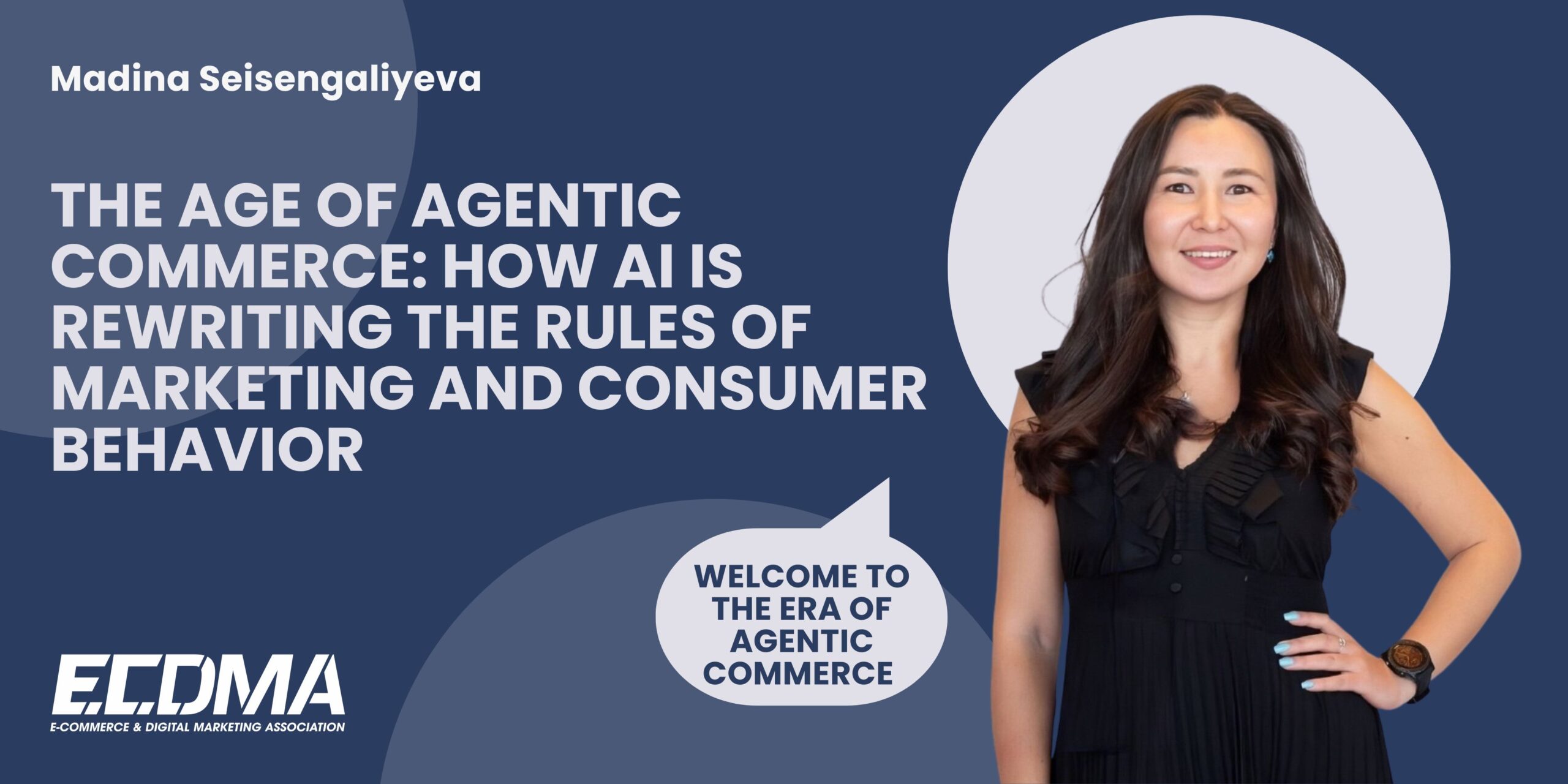
Welcome to the era of agentic commerce – an economy where autonomous AI agents act, negotiate, and purchase on behalf of consumers. According to McKinsey & Company’s 2025 report, The Agentic Commerce Opportunity, this new paradigm could account for $3 trillion to $5 trillion in global economic activity by 2030. In the U.S. alone, agentic transactions could exceed $1 trillion annually.
This is more than a technological evolution – it’s a behavioral revolution. And for marketers, it’s an existential one.
For decades, digital commerce evolved through simplification. One-click checkouts, personalized recommendations, and subscription renewals reduced friction but still required human initiation. We used technology to speed up the process, but the last word belonged to human. Agentic commerce breaks that boundary.
AI agents – powered by large language models (LLMs) and integrated through protocols like MCP (Model Context Protocol) and A2A (Agent-to-Agent) – are now capable of acting independently. They don’t just recommend – they execute. And this is total new way on technology penetration to our everyday lives and decisions.
A grocery agent, for instance, can track consumption patterns, predict when supplies will run out, and automatically place replenishment orders. A travel agent might proactively rebook a flight when a delay occurs. The consumer remains in control – but through delegation, not direct action. As McKinsey notes, this marks a profound shift “from consumer choice to delegated intent.”
The Future of E-Commerce in the Agentic Era
E-commerce, as we know it, will not disappear – but it will become invisible. The browser- and app-based interface will gradually give way to intent-driven commerce, where transactions occur seamlessly across ecosystems.
1. Marketplaces Will Evolve into Machine Networks
Current marketplaces like Amazon, Alibaba, and Shopify function as discovery engines for consumers. In the agentic economy, they’ll evolve into machine networks – back-end infrastructures optimized for data interoperability, pricing APIs, and authentication.
Winning platforms will no longer compete on user experience alone but on machine accessibility: how easily agents can retrieve, verify, and transact against their data.
2. Pricing Will Become Algorithmic and Dynamic
Autonomous agents negotiating in real time will drive algorithmic pricing ecosystems. This will compress margins, as agents detect inefficiencies instantly. Traditional brand premiums could erode unless justified by verifiable quality, sustainability, or ethical sourcing – attributes that AI systems can objectively evaluate.
3. Logistics and Fulfillment Will Go Predictive
Because agents act preemptively, logistics will move from reactive to predictive. Systems will forecast demand based on aggregate agent behavior, optimizing supply chains dynamically. Retailers will shift from selling what’s available to producing what will soon be needed.
4. Regulation Will Shape the Playing Field
Governments are already responding. The EU AI Act mandates explainability and accountability for autonomous systems, while OECD and WEF propose global governance frameworks for agentic transactions. Compliance will be as central to e-commerce competitiveness as innovation.
The New Architecture of Trust
At the heart of agentic commerce lies trust – not between brands and people, but between machines and their data sources.
McKinsey identifies five pillars defining trustworthy AI ecosystems:
Know Your Agent (KYA) – identity verification and certification for agents.
Human-Centric Oversight – ensuring user control and reversibility.
Transparency – making agent decision-making explainable.
Data Security – protecting sensitive consumer information.
In this landscape, trust becomes the infrastructure of commerce. Consumers will delegate decisions only when their agents act within certified, transparent, and auditable systems.
The Global Impact on Marketing and Advertising
If agents make decisions, how can marketers influence them? That question may define the next decade of marketing strategy.
The Attention Economy Is Ending
For 20 years, digital advertising was built on capturing human attention – clicks, impressions, and views. Agentic commerce renders that obsolete. AI agents do not watch ads, scroll feeds, or succumb to emotional storytelling. They analyze data – price, reliability, reputation – and act accordingly. The new competitive advantage is algorithmic visibility: being present, accessible, and interpretable to AI systems. Brands must invest in machine-readable brand assets – structured product data, verified credentials, and accessible APIs – rather than glossy campaigns.
Marketing Shifts from Emotion to Evidence
In the agentic age, persuasion gives way to validation. Agents will demand evidence: product traceability, ethical sourcing data, or verified user reviews. For marketers, this means transitioning from “brand storytelling” to data storytelling – the art of making values, performance, and credibility machine-legible.
Advertising Platforms Will Transform
Google, Meta, and Amazon will need to reinvent their business models. If AI agents bypass visual search and direct advertising, platforms must offer agent-facing services – interfaces where brand agents negotiate visibility within algorithmic systems. McKinsey anticipates that traditional ad spending could decline by up to 30% by 2035 as budgets shift from media buying to data integration and trust certification.
Future marketing teams will resemble data engineering teams. Their mission: design brand ecosystems that align with AI protocols and are “understandable” to autonomous systems. As Nadeau (2025) from McKinsey’s QuantumBlack division puts it, “Tomorrow’s marketers will compete not for the consumer’s attention, but for their agent’s confidence.”
The Rise of Agent-Ready Branding
Just as SEO defined the web era, Agent Readiness will define the next. Companies will invest in semantic infrastructure – clear taxonomies, verified sustainability data, and transparent pricing – to ensure their products surface during algorithmic decision-making.
Brands that fail to adapt may become invisible, even if beloved by humans.
Creativity in the Machine Age
Despite this mechanization, creativity won’t vanish – it will evolve.
The world will still need human storytelling, but its purpose will change: not to manipulate choice, but to shape the values and preferences that consumers embed in their agents.
In other words, emotional branding won’t disappear; it will move upstream. Humans will still decide what their AI should care about.
Marketers who can authentically define those values – and translate them into machine-readable form – will lead the next generation of global brands.
The Road Ahead
Agentic commerce is the next major evolution in how markets function. It represents not the automation of buying, but the autonomization of trust.
E-commerce will dissolve into background processes. Marketing will merge with data science. And the boundary between human intent and machine execution will blur.
For businesses, this demands more than adaptation – it requires reinvention.
The winners will be those who can:
Build transparent, explainable, and trustworthy ecosystems;
Translate human brand values into algorithmic logic;
And view artificial intelligence not as a channel, but as a customer in its own right.
As McKinsey concludes, “Agentic commerce is not just another digital revolution – it is the dawn of an economy where intelligence itself becomes the interface.”
Madina Seisengaliyeva is a results-driven marketing leader with over 15 years of experience driving digital innovation and managing large-scale teams across marketing, strategy, and commercial functions. As one of the early advocates of data-driven marketing in Kazakhstan, she championed analytical decision-making while leading the commercial team at NielsenIQ.
Recognized for her ability to align cross-functional teams around clear business goals, Madina combines strategic vision with hands-on execution to deliver measurable transformation. Today, she serves as the Director of YandexAds for Central Asia, where she leads the development and localization of YandexAds products across regional markets, providing ecosystem solutions to more than 100 partner clients.
Her career reflects a consistent passion for innovation, leadership, and the intelligent application of data to drive meaningful business growth.
To provide the best experiences, we use technologies like cookies to store and/or access device information. Consenting to these technologies will allow us to process data such as browsing behavior or unique IDs on this site. Not consenting or withdrawing consent, may adversely affect certain features and functions.
Functional
Always active
The technical storage or access is strictly necessary for the legitimate purpose of enabling the use of a specific service explicitly requested by the subscriber or user, or for the sole purpose of carrying out the transmission of a communication over an electronic communications network.
Preferences
The technical storage or access is necessary for the legitimate purpose of storing preferences that are not requested by the subscriber or user.
Statistics
The technical storage or access that is used exclusively for statistical purposes.The technical storage or access that is used exclusively for anonymous statistical purposes. Without a subpoena, voluntary compliance on the part of your Internet Service Provider, or additional records from a third party, information stored or retrieved for this purpose alone cannot usually be used to identify you.
Marketing
The technical storage or access is required to create user profiles to send advertising, or to track the user on a website or across several websites for similar marketing purposes.